First against Second
Plate
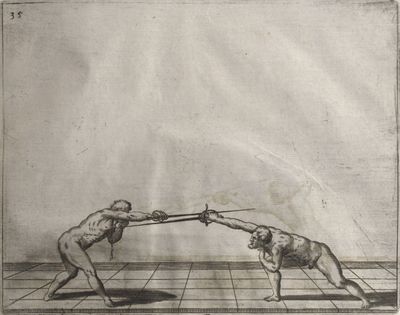
Translation
This wound in First, seen here against Second, must arise because both are in Third on the inside, and the striker goes to find the enemy blade, while the enemy takes the time just when the striker wishes to oppress that blade (opprimerli la spada), and disengages to the outside, turning the hand into Second and carrying himself beyond in order to wound above the sword in the opening made by the other's attempt to suppress it. But the striker, seeing the disengagement and the blow that was intended, takes that time, and turns from Third into First, lowering the whole body so much that the head remains entirely covered and defended by the hilt and the right arm; and he also shuts out the Second to the outside, because, in turning into First, the hilt goes so high that it covers the place at which the enemy aimed with his Second, so that the point which should have wounded above remains below and excluded by the opposing forte.
It may also happen that the enemy, instead of that thrust, wished to turn a riverso at the arm through the opening he saw; and the striker, by the same turning from Third into First, defends himself and covers that arm with the forte, so that the other can do nothing and in that same time remains wounded. Fabris is showing that First is not merely a guard of withdrawal, but a structurally powerful conversion against actions made from Second or against cuts directed high.
Analysis
- You go to find the enemy blade.
- He takes the time while you try to suppress or dominate it (opprimere la spada).
- He disengages outside, turns into seconda, and goes forward to strike over the sword.
- Seeing the disengagement, you seize the tempo.
- You turn from terza to prima.
- You lower the body deeply so the head is fully covered by hilt and right arm.
- Your hilt rises high enough to close the line he aimed at.
- His point, which aimed high, remains below and excluded by your strong.
- He may instead attempt a riverso to the arm; the same conversion terza → prima covers the arm with the forte and wounds him in the same time.