Fourth against a passing Second
Plate
Translation
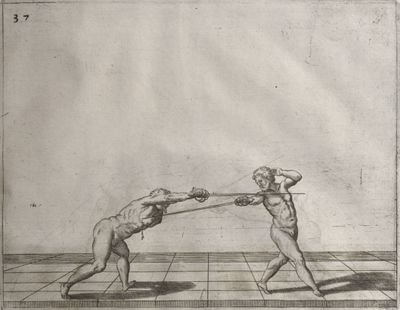
This wound in Fourth, which follows here against a Second, may occur in two ways. The first is because both combatants may have been in Third on the inside, and the striker went to find the enemy blade, while the other disengaged in Second above the enemy sword and passed beyond with the left foot. The striker, lowering the point without disengaging and leaving the arm somewhat angled inward, as is seen, with the hand in guard of Fourth, and by turning the body with the left foot, met the enemy who was coming and wounded him in the flank beneath the right arm, and thus that man's sword passed vainly without being touched.
The second way may be that the said striker disengaged to the outside, and the other sought to take that time to wound above in Second. The striker then did nothing but lower the point, which had gone to the outside, beneath the enemy sword, leaving the hand in the same place but turning it into Fourth, yet without extending the arm, and turned the body, taking out of presence all that part which had been visible while standing in guard.
Analysis
- You go to find the enemy blade.
- He disengages in seconda over your sword and passes with the left foot.
- You lower your point without disengaging.
- You let the arm angle inward.
- Your hand remains in quarta.
- Turning the body with the left foot, you meet the incoming enemy.
- You hit him under the right arm / in the side.
- His blade passes empty.
- You disengage outside.
- He seeks to take that time with seconda above.
- You do nothing but lower the point, now outside, under his sword.
- You keep the hand in place but turn it into quarta.
- Without extending the arm, you turn the body and remove the exposed line from presenza.