Fourth against Second
Plate
Translation
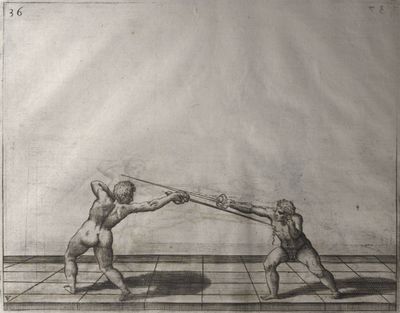
This here, which is a Fourth, has wounded a Second. It happened because, both standing in Third on the inside, the one who is wounded went to find the enemy sword, and the striker wished to turn from Third into Second and lower himself beneath the sword in the time that the enemy point was going fuori di presenza. Because the striker, seeing such an effect, did not finish going to the sword, but directed his point to the other's body and carried the hilt where he had intended to place the point, turning the body and the right foot as he carried it forward, while leaving the hand at the enemy weak, in this way he remained defended and met the enemy while he was bending in order to go below and carrying himself forward.
Likewise it may be that the wounded man was in Second on the inside, and the striker went to find his sword; and that the wounded man wished to disengage from that Second in order to wound on the outside above the sword, and the striker also disengaged and carried the hilt where he had wished to place the point, and by that turn of body, foot, and hand wounded in the very point in which the other believed he would wound.
Analysis
- You go to find the enemy blade.
- He intends to turn from terza to seconda and drop under your sword while your point goes fuori di presenza.
- Seeing this, you do not finish the engagement.
- You direct your point to his body.
- You bring the hilt where you had intended to put the point.
- You turn body and right foot forward.
- You keep your hand against his weak.
- You meet him while he is lowering and advancing.
- Enemy is in seconda inside.
- You go to find his blade.
- He wants to disengage in seconda and hit outside above the sword.
- You disengage as well.
- You carry the hilt where you meant to carry the point.
- With the turn of body, foot, and hand, you hit in the moment he thinks to strike.