Outside Fourth against angled Third
Plate
Translation
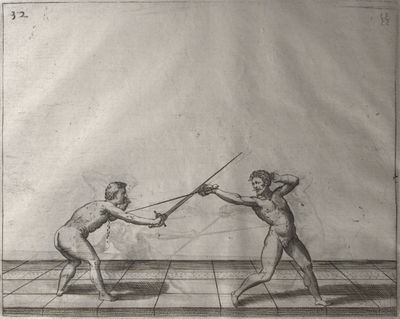
According to the order there follows another wound in Fourth, on the outside of the enemy sword, which is in angled Third (terza angolata). It may have been made thus: both being on the inside, and the one who is wounded remaining in that angled Third, the other went to find his sword, and the wounded man wished to disengage in Third to the outside. In the same time the striker turned the hand into Fourth, not by extending the arm, but by carrying the hand far toward the inside and as high as the shoulder, and by advancing the right foot, turning it in the air so that when it came to the ground it was already turned in the manner seen. By that act the body also turned, so that all that part of the body which had been opposed to the enemy was lifted out of presence; and he came to make an angle of the sword, which entered through the other angle formed by the enemy blade. Thus the more the enemy struggled to drive it away, the greater the wound would have become.
It may likewise have happened that the wounded man went to find the enemy blade with that angled Third on the outside, while the enemy blade was in Second; and that the same enemy yielded from Second into Fourth with a turn of the body, and wounded in the same instant in which the other thought he was finding the sword.
Analysis
- You go to find the enemy blade.
- The enemy wants to disengage outside in terza.
- In the same time you turn the hand into quarta.
- You do not extend straight away.
- You carry the hand inward and high, about shoulder level.
- You advance the right foot, turning it in the air.
- This turns the body and removes the exposed line from presenza.
- Your blade forms an angle and enters through the enemy's angle.
- The more he tries to force it away, the stronger your hit becomes.