Second against Third using chiamata and the left hand
Plate
Translation
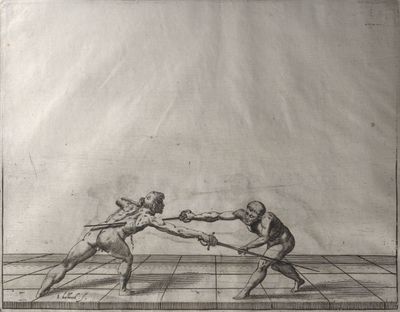
Here follows a wound in Second against Third, arising because, with both in Third on the outside, the striker makes an invitation (chiamata) by turning the sword from Third into a traversed Second to the inside, with the point out of presence, and by turning the left flank so far forward that he uncovers the whole chest to the enemy, though the sword is held so low that the enemy can only wound above it; at the same time he keeps the left hand above the forehead. While the enemy comes to wound that opening in the time of the invitation, the striker with that left hand pushes the enemy sword outward by the left flank and, in the same time, passes with the left foot, keeping the body low and disengaging in that same Second. Thus he wounds the enemy in the chest, extending the right arm as much as possible and accompanying it with the right side brought forward, while the toes of the left foot are turned outward so as to carry the body farther away from the enemy sword.
This is the clearest formal chiamata in the sequence. Its point is not merely to show a provocation, but to show the conditions of a proper invitation: the opening must be such that the enemy can only answer in a determinate way, while the striker has already prepared the body, hand, and line by which the answer is to be defeated.
Analysis
- You make a chiamata by turning the sword from terza into seconda, traversed inward, with the point fuori di presenza.
- You turn the left flank so far forward that the whole chest appears open.
- You hold the sword so low that the enemy can only strike above.
- You hold the left hand before the face.
- When he comes to strike the opening in the tempo of the chiamata, you push his sword outside your left flank with the left hand.
- In the same time you pass with the left foot.
- With the body low, you disengage in seconda.
- You wound him in the chest with the right arm extended as far as possible.
- The left toes turn outward to carry the body away from his sword.