Second against Fourth, right foot advanced
Plate
Translation
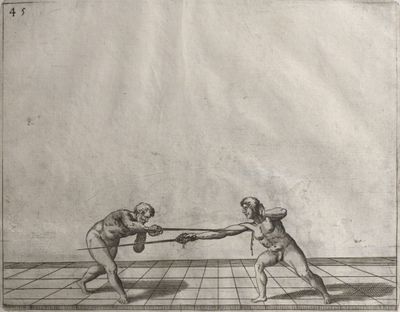
This other will likewise be a Second, but against a Fourth advanced with the right foot. It is caused because, both combatants being in Third on the outside, the striker disengaged without waiting for time or enemy provocation, and the other, taking that occasion, wished to wound in Fourth. But the first, immediately turning the hand into Second and the body so that the left side came forward, and turning out the rear or heel of the right foot, laid the edge of his left hand upon the enemy sword and wounded that enemy with the said Second in the chest.
It may no less have proceeded because both were in Third on the inside, and the striker had lowered the sword, leaving himself uncovered, and the other had pushed himself forward in Fourth; whereupon the striker raised the hand into Second, turning the profile of the body and keeping the right flank back, as that which bore the greater danger, and thus parried with the hand. For that Fourth, which is seen to go so low in order to wound, is caused by the hand of him who parries, which pushes it down, because as to its point that Fourth would naturally go to wound toward the enemy chest.
Analysis
- You disengage without waiting for time or provocation.
- He uses that occasion to thrust in quarta.
- You immediately turn the hand into seconda.
- You bring the left side of the body forward.
- You turn the heel/toes of the right foot outward.
- You place the edge of the left hand on his sword.
- You parry with the hand and hit him in the chest with seconda.
- Both are in terza inside.
- You lower your sword and leave yourself open.
- He thrusts in quarta.
- You raise the hand into seconda.
- You change the body's profile, keeping the right side back.
- The left hand forces his low quarta downward while you wound.