Hit in Third against Third
Plate
Translation
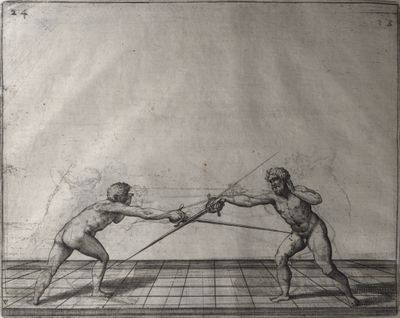
The following will be a wound of Third against another Third, caused because both found themselves on the outside, and because the one who wounded had moved as if to go and find the enemy sword. The other, seeing the apparent time, but without considering the breadth of the measure at which the adversary stood, and that he had moved nothing but the point, came forward with the foot to disengage on the inside and wound in Fourth, or else to occupy the enemy sword, and so approached into close measure. But that enemy, who had moved craftily only in order to make this man move, did not finish going to the sword. Instead, seeing him begin to lower his point in order to disengage it, and seeing him come forward with the foot, he likewise let his own point fall in that same Third, lowering the body, and came with the hilt to find the enemy weak, thereby impeding his disengagement; and in the same instant, pushing forward with the right foot, he made the wound beneath the enemy sword on the outside.
Thus one must hold as a true rule that when an enemy has the sword free while keeping the feet still, and comes in order to make some gain, one should not allow oneself to be put in danger, but should choose rather to gain some advantage without approaching, and indeed rather by withdrawing, because the motion of the foot is much longer than that of the sword. But if one had already occupied the enemy sword, and he wished to free it, then—even though he did not move his feet—one might approach with a foot and gain it on the other side, in order later to wound him when he moved again. Therefore the reason for going forward when the enemy moves lies in the advantage of having first gained his sword; for when it is free, it brings greater danger, as is seen from the figure.
This is one of Fabris' clearest answers to the disengage: provoke the line-change, intercept it before it finishes, and wound under the sword rather than attempting a broad recovery.
Analysis
- You move as though to gain the blade (andare per acquistare / trovare la spada).
- The enemy sees the apparent time and tries to disengage inside to wound in quarta.
- Your first motion was only to make him move.
- As he lowers the point and advances, you also let your point fall and lower the body.
- You take his weak with your forte/hilt, stop the disengagement, and wound outside underneath in terza.