First hit in Fourth against Third
Plate
Translation
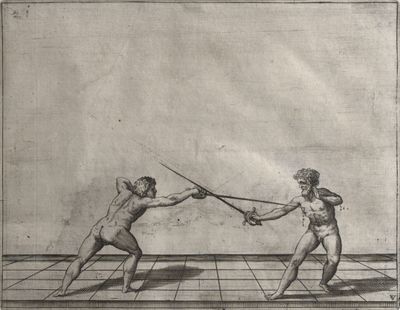
Here is the first wound in Fourth (quarta), represented by the following figure, made a piè fermo against a guard of Third (terza). It may have come about because the one who was in Third wished to feint a wound on the inside (fingere di ferire di dentro), while the other too was in Third, and so he carried himself forward (si è spinto inanzi) in order to make him parry. But the other, taking the tempo (pigliando il tempo) and bringing the hilt to the enemy point (portando il finimento alla punta nimica), went with his own point to wound, advancing the right foot, bending the body, and turning the hand into Fourth, and thus met and wounded the enemy, as is seen, at the very instant that he was coming on. This caused him to be unable to parry, since his foot was in the air and he was coming forward.
Likewise it may be that both were in Third on the outside, and that the one who remained wounded wished to disengage to the inside (cauare di dentro), advancing sword and body so as to place his adversary under the necessity of parrying, with the intention of wounding him in that time by turning from Third into Second and lowering the body, or else of returning to the outside out of that same Third in order to wound above the sword. Both of these designs would have succeeded if the said adversary had done as he desired. But the one who stood firm, with the sword free in his hand (con la spada libera in mano), and who was at wide measure (misura larga) waiting for the time either to wound or to gain some advantage, as soon as he saw the movement of the enemy sword accompanied by the body that was being carried forward, recognized that the enemy, though he had not yet moved the foot, nevertheless could not break measure (rompere di misura), since one cannot approach and withdraw in the same instant.
From this one may understand how grave a danger it is to move without time (mouersi senza tempo), especially when the enemy sword is free, and one approaches while the enemy is already settled at wide measure. If a man were constrained to move in order to free himself from some danger, it would be better to do so by withdrawing rather than by approaching, especially when the enemy stands still and is seeking to free himself; for then, if that enemy wished in that time to wound, one could defend and offend in the same instant. Even if the sword and body had moved, provided the foot remained still, one could still save oneself so long as one remained at wide measure. But at close measure (misura stretta) every small motion carries with it great danger, as has been shown in the discussion of measures and times.
Moreover, one must consider that while the enemy sword is free and steady, to wish to feint against it is nothing else, in Fabris' judgment, than to seek one's own ruin fruitlessly; for the one who wishes to feint can never wound, even if the other goes to parry, provided only that he keeps his feet still. And if after making the feint he then wishes to wound, the other may break measure, so that he will not arrive and will remain disordered, with danger of being wounded before he can recover. Therefore, if one wishes to feint, it is necessary either to await some motion of the adversary, or else not to leave the enemy sword free, but first to occupy it (occuparla) so that it cannot wound in the line where it lies. After that one may feint, never abandoning the advantage (vantaggio); and in making such a feint one must go forward, so that if the enemy does not parry the feint may itself wound, and if he does parry, one may in the mutation arrive at the body before he can save himself by breaking measure. But if, when the feint is made, the enemy breaks measure, one must not continue, because he is then too far away; instead one must stop and return to gain again (tornare ad aquistare). Thus if the one here seen wounded had observed this rule, he would rather have been the striker than the struck, or at least he would have saved himself.
Upon this present wound Fabris has made a long discourse on advantage and danger, not only on this, but also on how it arose and how in another form it might have arisen, and further on what was good for the safety of the wounded man. For before the offense there were many ways to remedy it, whereas after the fact nothing is of use. Therefore in the plays that follow he says only the cause and effect of the wounds, omitting the rest so as not to weary the reader.
The point of the play is that the defense and the wound are made in one action. Fabris is not describing a separate parry followed by a thrust, but a taking of the tempo while the enemy is still in motion.
Analysis
- The enemy makes an inside feint or presentation to draw the parry (fingere di ferire di dentro).
- He comes forward bodily (si è spinto inanzi).
- You seize the tempo (pigliare il tempo).
- You bring the hilt to the enemy point (portare il finimento alla punta nimica).
- You extend, advance, turn the hand into quarta, and wound before his advance is complete.